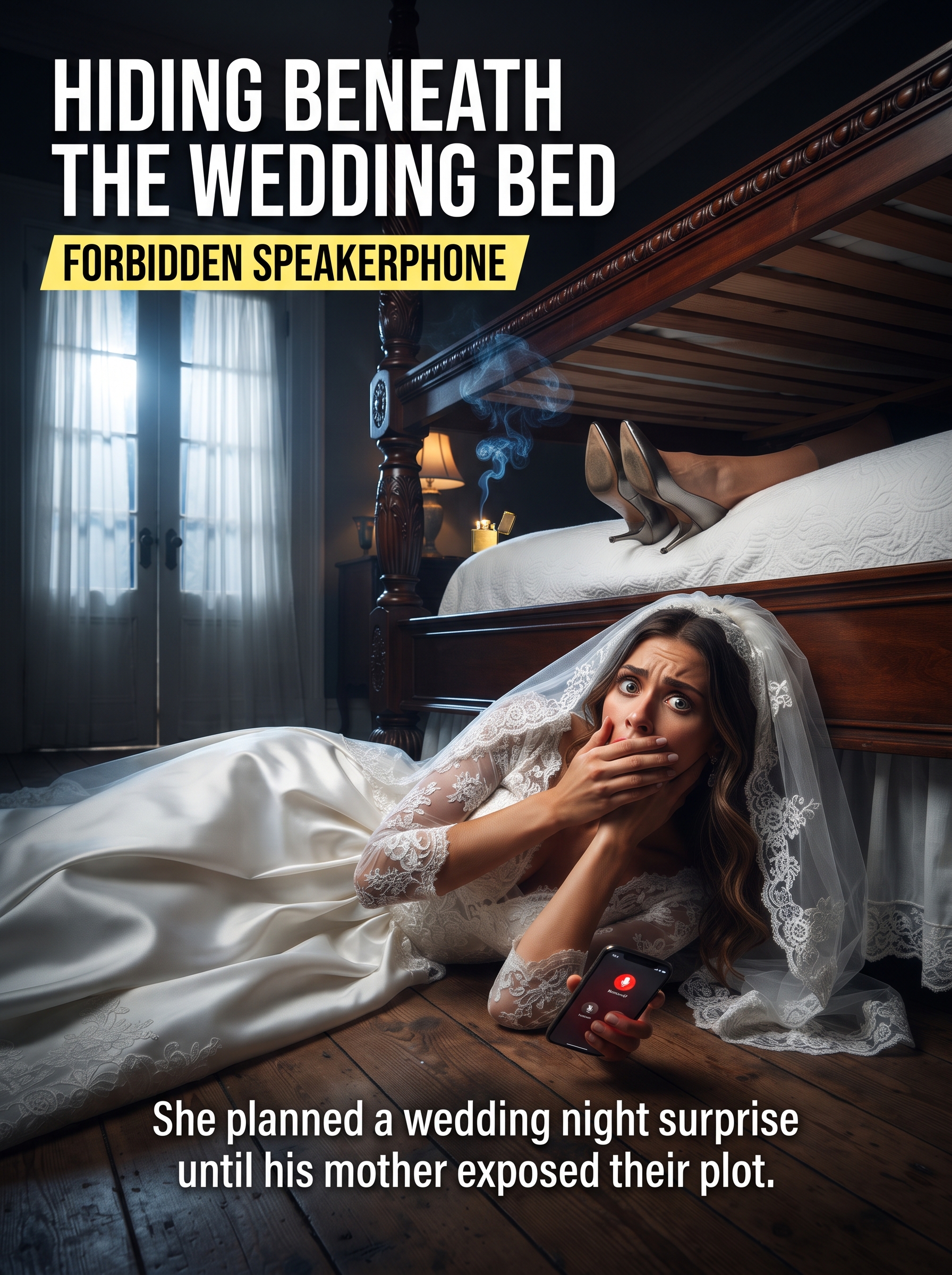
Crouched beneath the mattress of our bridal suite waiting to jump out in my wedding gown, I watched my new mother-in-law sit above me, click a lighter, and place her son on speaker. What they confessed about the Savannah condo and my “nobody” father turned my heart to ice—and ignited a ruthless reckoning.
The dust against my cheek smelled of old floor wax and lavender sachets. Beneath the king-sized four-poster bed of the historic Savannah inn, my white satin gown was bundled tightly around my knees. A jagged sliver of wood from the antique slats had snagged the lace trim of my veil, tugging gently at the pins in my hair every time I held my breath.
I had been crouching there for five minutes, trying to suppress the nervous giggles bubbling in my chest. We were twenty-four, barefoot, and married. The reception downstairs had finally wound down, the last brass notes of the jazz band fading into the muggy coastal night. When Owen stepped out to escort his great-aunt to her taxi, I had kicked off my heels, dropped to my hands and knees, and scrambled into the dark recess beneath the dust ruffle.
I had pictured it so clearly: Owen loosening his bowtie, tossing his jacket across the settee, walking toward the bathroom, and then me sliding out from the cedar shadow with a triumphant, “Got you!”
Then the heavy brass doorknob turned.
The door didn’t click open with Owen’s tentative, gentle touch. It swung wide, hitting the rubber wall-stop with a sharp, impatient thump.
The footsteps that crossed the heart-pine floorboards were hurried and sharp—the unmistakable, hard strike of four-inch designer stilettos.
Through the narrow slit between the floor and the scalloped hem of the ivory duvet, I caught sight of metallic pewter heels.
Lorraine.
My breath caught in my throat. My new mother-in-law had spent the entire evening patrolling the perimeter of the ballroom, whispering to her bridge club companions while casting critical glances at the low-country boil buffet and the mason jar centerpieces my cousins had spent three days assembling.
The mattress springs directly above my spine dipped with a heavy, sudden groan as Lorraine sat down. The cedar slats pressed against the small of my back, pinning me flat against the polished timber. I held my breath, terrified that the rustle of my stiff silk petticoat would give me away.
A sharp, metallic flick-clink echoed through the room.
The unmistakable, bitter reek of burning tobacco and sulfur drifted beneath the bed frame, sharp enough to make my eyes water.
Owen had sworn to me, during our second month of dating, that his mother had quit smoking twenty years ago when his father had died of lung complications. It was one of the small, pious myths he spun about her—a woman of iron willpower, pristine health, and unimpeachable Southern decorum.
A digital chime broke the silence as Lorraine tapped her touchscreen.
She pressed the speakerphone icon with a sharp tap of her manicured acrylic nail, setting the device face-up on the mahogany nightstand three inches above my head.
The line rang twice.
“Hello, Owen?” Lorraine’s voice cut through the quiet room, crisp and businesslike, stripped completely of the honeyed drawl she used around the wedding guests. “I’m in the bridal suite. Where is your wife?”
The speaker crackled. When the voice answered, a cold, sickening sensation washed over my skin, leaving my limbs entirely paralyzed.
It was Owen.
His voice didn’t carry that soft, hesitant warmth I had fallen in love with across college study tables. It was flat, clinical, and devoid of affection.
“She’s probably wandering around with her friends,” Owen said. “Don’t worry, Mom. She has no idea what we’re doing.”
My fingers dug into the cold heart-pine boards. My heart pounded so violently against my ribs that I was certain the vibration would rattle the mattress springs above.
Lorraine took a long, slow drag from her cigarette, blowing the smoke toward the open balcony doors with a low, contented chuckle.
“Good,” she said. “Is the condo in Savannah under her name yet?”
“It is,” Owen replied, his tone chillingly casual. “I told her it would make her feel secure. She thinks I bought it for her, but I kept the receipts. Give it a few months, we’ll claim we are incompatible, and I’ll use the purchase records to take the property when we split.”
A hot, suffocating wave of nausea rose in my throat, threatening to choke me.
The three-bedroom Victorian condominium on Gaston Street overlooking Forsyth Park had been our proudest achievement. Three weeks before the wedding, Owen had brought me to the title company’s office with tears in his eyes, sliding the warranty deed across the table with a trembling hand.
“A woman should always have something of her own, Mara,” he had whispered, kissing my knuckles in front of the closing officer. “My father left my mother with nothing. I never want you to feel dependent on me.”
I had wept. I had called him my protector, my partner, the finest man I had ever known.
Now, trapped in the cedar dust beneath his mother’s shoes, the reality struck me with the force of an oncoming freight train.
The closing funds hadn’t come from Owen’s savings as an assistant city planner; they had come from a short-term promissory bridge note taken out against his mother’s brokerage account. By keeping the title in my sole name while retaining the traced funding wire under his personal accounts, he was setting an intentional equitable trap: let me shoulder the legal property tax liabilities, use my pristine tier-one credit score to secure the low-interest long-term refinance, and then sue for full proprietary restitution during an expedited divorce, claiming I had fraudulently converted his family’s personal funds.
Lorraine tapped the ash into an antique crystal candy dish on the bedside table.
“She is so easy to manage,” Lorraine continued, a cruel smirk audible in her voice. “That little apartment you showed me was pathetic.”
My mind raced back to Easter Sunday. Owen had driven his mother to the small, rent-stabilized apartment on 42nd Street in Savannah where my grandmother had lived for forty-five years before she passed. My father had kept the lease, refusing to surrender the worn linoleum and the chipped laminate cabinets because it was the sacred place where he had studied by the light of a single floor lamp while working the night shifts as an apprentice draftsman.
Lorraine had walked through those four rooms with a scented handkerchief pressed to her nose, eyeing the worn sofa and the plastic slipcovers with visible, shuddering contempt.
She had looked at that apartment and assumed we were nobodies.
She had looked at my simple, store-bought wedding dress, my lack of country club memberships, and my father’s quiet, unassuming demeanor in his off-the-rack department store suit, and decided that my family was destitute, desperate, and easily devoured.
“She thinks she married up,” Lorraine continued, crushing the cigarette butt against the crystal with a grinding twist. “A girl like that will not fight people who know how the world works.”
Owen laughed softly over the speaker—a quiet, derisive chuckle that tore away the last lingering fragment of my innocence.
“Exactly,” Owen agreed. “Her father is a nobody. She will be grateful for whatever we let her keep.”
My hand flew to my mouth, pressing against my lips to stifle the ragged, suffocating sob clawing its way up my throat. But as the tears spilled over my lashes, hot and blinding, the sorrow didn’t stay sorrow.
It hardened.
It congealed into an icy, crystalline fury that froze the trembling in my fingers.
They thought my father was a nobody.
They thought David Vance was a retired mechanic living off a modest municipal pension. They had never bothered to ask why my father spent forty weeks a year flying to Washington, Houston, and Cape Canaveral. They had never bothered to look beyond his grease-stained canvas jackets and his battered Ford truck to discover that the quiet man who grew tomatoes in his backyard was the Senior Fellow and Chief Structural Architect for Vance-Lockheed Dynamics, holding fourteen federal patents on titanium alloy airframes, answering directly to the Department of Defense.
Lorraine stood up from the bed, the mattress lifting off my back with a sudden release of pressure.
Her heels clicked toward the full-length mirror near the door.
“Remember,” she said, her voice dropping into a harsh, instructional snap. “No weakness from the start. Let her know who makes decisions in that house.”
“I’m on my way up now, Mom,” Owen said. “See you at breakfast.”
The call disconnected with a sterile digital click.
The heavy bedroom door opened and clicked shut behind her, the lock turning from the outside.
For two long, terrifying minutes, I remained entirely motionless beneath the bed frame, staring at the scalloped dust ruffle, the bitter reek of Lorraine’s cigarette smoke stinging my throat.
Then I reached into my small satin evening clutch lying on the floorboards beside my knee.
I pulled out my smartphone.
The screen was glowing faintly in the gloom.
The voice memo application—which I had tapped three minutes before crawling under the bed to record Owen’s anticipated laughter for our wedding video—was still running.
The red digital timer blinked steadily: 07:42… 07:43… 07:44…
Every word.
Every cruel laugh, every calculated property maneuver, every insult leveled against my father, preserved in pristine, uncompressed audio.
My hands didn’t shake as I tapped the square stop icon and instantly backed the file up to my personal cloud drive and my father’s private encrypted server.
I pushed the dust ruffle aside and crawled out into the moonlight.
My satin gown was streaked with gray floor dust across the bodice. My lace veil hung in ragged shreds from my hair, torn by the wooden slats. I walked over to the dresser, looked at my reflection in the gilded mirror, and saw a woman I had never seen before: a bride whose heart had been murdered, but whose mind had suddenly become as cold, precise, and lethal as an engineer’s blueprint.
I slipped off the diamond engagement ring—a ring Owen had supposedly bought with three months of his salary, which I now knew was merely another line item on his mother’s balance sheet.
I left it sitting squarely on top of the crushed cigarette butt inside the crystal dish.
Then I unlocked my phone and dialed the direct, unlisted satellite number I had memorized when I was eight years old.
The phone rang half a cycle before the line clicked open.
“Dad,” I said, my voice as calm and sharp as a surgeon’s scalpel. “I need you to contact your attorney.”
His voice cut through the receiver, entirely alert, devoid of the mild-mannered fatherly facade he wore around the neighbors.
“What happened, Mara?”
I looked down at the torn lace in my hands.
“We have an engineering problem, Dad,” I said quietly. “And I need you to bring the structural team.”
My father arrived at the side entrance of the historic inn twenty-five minutes later.
He didn’t arrive in a cab, and he didn’t arrive looking like the sleepy father of the bride who had just finished dancing the father-daughter waltz. He drove his dark gray, armored company Suburban, stepping out into the humid coastal drizzle wearing his dark work trousers and a black windbreaker bearing the discreet, unadorned emblem of Vance Aerospace Systems.
Beside him stepped Arthur Vance—my father’s younger brother, a formidable senior litigation partner whose firm represented maritime and commercial defense contractors from Savannah to London.
I was standing beneath the dripping live oaks by the service gate, wrapped in my dark woolen trench coat, my ruined satin gown tucked into a large canvas duffel bag at my feet.
Dad didn’t ask questions on the street. He didn’t offer hollow platitudes. He pulled me into his arms, his woolen coat smelling of cedar and cold rain, holding me against his broad chest until the trembling in my knees finally subsided.
“Arthur,” Dad said quietly over my shoulder, his voice as level and dangerous as a loaded chamber. “Take her bag. We’re going to the regional office.”
We drove across the cobblestones of the river district to a nondescript, brick commercial building on Bay Street. To the public, it was merely an engineering annex with frosted windows and a brass directory plate reading Vance Industrial Consulting. Inside, behind biometric security doors and soundproof glass, sat a full-scale corporate communications suite with secure servers and video conferencing terminals.
Arthur sat me down at the long conference table, placing a mug of hot black coffee into my hands, while Dad plugged my smartphone into the audio diagnostic console on the wall.
The recording played.
In the sterile silence of the room, Lorraine’s voice and Owen’s hollow laughter filled the air:
“…Give it a few months, we’ll claim we are incompatible, and I’ll use the purchase records to take the property when we split… Her father is a nobody. She will be grateful for whatever we let her keep…”
Dad stood motionless by the window, his hands clasped behind his back, watching the dark, rain-swept waters of the Savannah River.
The quietness that settled over my father was terrifying. When my mother had died during my junior year of high school, Dad hadn’t broken furniture or shouted at the heavens; he had sat at his drafting table for forty-eight hours straight, designing an automated telemetry stabilization system that later saved seventy-two naval aviators during a carrier storm.
When David Vance went quiet, it meant the calculations were finished, the stresses had been measured, and the demolition was about to begin.
Arthur leaned back in his leather chair, a slow, cold smile spreading across his silver-stubbled face.
“Fascinating,” Arthur murmured, tapping a yellow legal pad with a gold ballpoint pen. “Truly fascinating.”
“Can he take the condo, Uncle Arthur?” I asked, my voice tight.
“Take it?” Arthur let out a dry, razor-sharp bark of laughter that had no humor in it. “My dear child, Owen Reed has executed the most spectacularly incompetent legal maneuver I have witnessed in thirty years of commercial practice.”
Arthur opened his laptop, typing with rapid, practiced keystrokes, pulling the county property records and banking filings directly from the state registrar’s private portal.
“First,” Arthur explained, turning the screen toward me, “in the state of Georgia, real property conveyed solely to one spouse via a recorded warranty deed during or immediately prior to marriage is legally presumed to be separate, non-marital property unless there is an explicit, executed co-ownership agreement. There is no such agreement.”
He tapped the second file on the screen.
“Second, regarding the funding wire: Owen didn’t wire the money from his personal account. Look at the routing identifier. The five hundred and forty thousand dollars used to satisfy the purchase price at the title office came directly from Lorraine Reed Enterprises LLC—a retail property holding company registered in Delaware.”
Dad turned away from the window, his hazel eyes gleaming with cold, mathematical precision.
“Commercial third-party funds,” Dad stated.
“Precisely, David,” Arthur nodded, his grin widening into that of an apex predator. “Lorraine transferred company operating funds into a residential closing without an executed mortgage instrument, without a recorded promissory deed of trust, and without a commercial security agreement. On paper, under federal tax law, that transfer is either an unrecorded, illegal corporate loan to an unrelated individual… or it is an unconditional, completed gift.”
Arthur leaned across the table, looking straight into my eyes.
“Furthermore, Mara, because Owen was acting as an uncompensated managing agent for his mother’s firm while simultaneously executing civil contracts in this county, their recorded conversation establishes an explicit, premeditated conspiracy to commit fraudulent conveyance and wire fraud.”
Dad walked over, placing his heavy, calloused hand on my shoulder.
“They thought we were nobodies, Mara,” Dad said softly, his voice dropping into a register that made my spine tingle. “They thought my daughter was a charity case who would beg for scraps in a divorce court.”
“What do we do, Dad?” I asked.
Dad looked at his brother.
“Arthur,” Dad instructed. “Call the United States Attorney’s regional tax enforcement division in Atlanta. Then call the managing partner of First Savannah Commercial Bank. I believe Owen’s municipal consulting contract with the city comes up for renewal on Monday morning.”
Arthur picked up his satellite phone with a flourish.
“It does, David,” Arthur purred. “And I do believe the city ethics commission would be extraordinarily interested in reviewing a recorded audio file detailing a municipal planner using fraudulent shell transactions to launder residential equity.”
Dad turned back to me, reaching into his pocket, pulling out a set of heavy brass keys on a leather lanyard.
“Go to sleep in the guest suite upstairs, Mara,” Dad said, his eyes filled with profound, protective warmth. “Your wedding night is over. But tomorrow morning, we are going to attend their breakfast.”
Sunday morning broke over Savannah with a heavy, golden coastal heat that set the Spanish moss dripping beneath the ancient live oaks of Forsyth Park.
At nine o’clock, the private garden terrace of the historic inn was dressed for the post-wedding champagne brunch.
Three long banquet tables were covered in white linen, decorated with fresh hydrangeas, crystal carafes of freshly squeezed orange juice, and three-tiered silver stands piled high with warm peach scones, smoked salmon blinis, and artisanal cheeses.
Seated at the center table, looking regal, refreshed, and triumphant in a tailored lavender linen suit and oversized pearl earrings, was Lorraine Reed.
Beside her sat Owen.
He wore a crisp white linen shirt with the collar unbuttoned, a new gold signet ring on his pinky finger, looking tanned, relaxed, and utterly unburdened as he laughed with two of his former college fraternity brothers.
On the table before them sat a chilled bottle of French champagne and an empty seat with my name card standing proudly beside a sterling silver place setting.
“Has anyone seen the bride this morning?” one of Owen’s friends asked with a playful grin, nudging him with an elbow. “Did you exhaust her that thoroughly, Reed?”
Owen threw his head back, letting out an easy, confident laugh that caused the surrounding tables to chuckle.
“Mara’s probably sleeping in,” Owen said, waving a hand with smooth, patronizing charm. “She isn’t used to luxury accommodations like this. Her family’s idea of a vacation is camping in a state park with a cooler of sandwiches. I told the front desk to send up a tray of fruit around ten.”
Lorraine took a delicate sip of her champagne, her red lips curving into a smug, victorious crescent.
“Well, she’ll have to learn how to keep a proper schedule, darling,” Lorraine remarked, her voice carrying clearly across the terrace to the thirty guests sipping mimosas. “A woman who represents the Reed family cannot spend her mornings hiding under the covers. She has a household to organize.”
From the arched brick entryway leading from the garden courtyard, a sharp, rhythmic sound began to echo across the flagstones.
Click. Click. Click.
The sound was accompanied by the deep, heavy footsteps of two men walking with measured, militaristic precision.
Every head on the terrace turned toward the archway.
Stepping onto the sunlit terrace was not a sleepy bride in a silk robe.
It was me.
I was dressed in a tailored, charcoal-gray wool skirt suit with an ivory silk blouse buttoned to the throat, my hair swept back into an immaculate, severe French twist. My makeup was pristine, my eyes completely clear of tears, and my chin held high.
On my left wrist was my mother’s vintage gold watch, ticking with steady, mechanical defiance.
Flanking me on my right was my father, David Vance—not wearing his off-the-rack department store suit, but an impeccably tailored navy suit cut from British wool, radiating the unshakeable, terrifying authority of a man who commanded billion-dollar aerospace programs.
On my left stood Uncle Arthur, carrying a thick, black leather litigation briefcase with polished brass latches that gleamed like gold in the morning sun.
Owen’s smile died on his lips.
He slowly lowered his champagne flute, his brow furrowing into an awkward, confused frown as his eyes swept over my tailored suit.
“Mara?” Owen stammered, half-rising from his chair, adjusting his collar with a nervous twitch. “Sweetheart… what are you wearing? Why are you dressed like you’re going to a corporate board meeting? Where is your sundress?”
Lorraine didn’t stand up. She set her glass down with a sharp, brittle click against the linen, her eyes narrowing into cold, aristocratic slits.
“Mara, darling, this is an informal family brunch,” Lorraine said, her Southern drawl dripping with synthetic sweetness. “You look remarkably severe. And David… how lovely of you to join us. We didn’t expect you to stay in town after the reception.”
My father did not look at Lorraine. He did not smile.
He walked to the head of the banquet table, pulled out the empty chair bearing my name card, and seated me with quiet, reverent dignity.
Then, Dad remained standing behind my shoulder, his large, scarred hands resting firmly on the back of my chair, looking down at Owen and his mother like an engineer inspecting two rusted, failing bolts.
“We aren’t here for brunch, Lorraine,” I said.
My voice was quiet, yet it carried an acoustic clarity that caused the chatter across the entire terrace to fall completely silent.
Owen blinked, a nervous, patronizing chuckle escaping his lips. “Mara, what are you talking about? Did you wake up on the wrong side of the bed?”
“No, Owen,” I replied, looking directly into his clear blue eyes—eyes that had lied to me for two solid years. “I woke up on the right side of the bed. Right around two in the morning, when I was lying on the hardwood floor beneath the dust ruffle.”
The terrace went dead quiet.
Lorraine’s posture stiffened instantly. The color in her cheeks, usually flushed with morning champagne, drained away in a matter of seconds, leaving her a pale, powdery gray beneath her makeup.
Owen frowned, completely uncomprehending. “Beneath the… what?”
I reached into my leather handbag, pulled out a small, portable high-definition Bluetooth speaker, and placed it squarely in the center of the white tablecloth, right between the crystal fruit bowl and Owen’s champagne glass.
I picked up my smartphone.
“I believe you both left something in our bridal suite last night,” I said softly.
I tapped the screen.
The external speaker chimed with a clear, sharp tone before the recorded audio filled the sunlit terrace with horrifying, pristine fidelity.
The sound of four-inch heels clicking across the hardwood floorboards.
The distinct, metallic flick-clink of a cigarette lighter.
Then came Lorraine’s voice, cold, sharp, and stripped of every drop of Southern honey:
“Hello, Owen? I’m in the bridal suite. Where is your wife?”
Owen’s own voice blasted through the garden, echoing off the historic brick walls of the inn:
“She’s probably wandering around with her friends. Don’t worry, Mom. She has no idea what we’re doing.”
Across the terrace, forty wedding guests—Owen’s fraternity brothers, his colleagues from the municipal planning office, my cousins, and Lorraine’s high-society bridge club—froze in mid-motion.
A silver fork clattered against a porcelain plate three tables away with a sharp, ringing crack that sounded like a gunshot.
Owen leaped to his feet, knocking his chair backward, sending it crashing into the boxwood hedge.
“Turn that off!” Owen shouted, his voice cracking into a desperate, panicked shriek. He lunged across the white linen, his hand reaching wildly for the speaker. “Mara! Turn that damn thing off right now!”
My father didn’t shout. He didn’t raise his fist.
David Vance simply shifted his weight forward, his right arm extending across the table with the speed and finality of an industrial press. His large, iron-hard hand caught Owen by the lapels of his white linen shirt, stopping the two-hundred-pound young man dead in his tracks, shoving him backward into the table until the crystal glasses rattled violently.
“You will not touch my daughter,” Dad said.
His voice was a low, vibrating rumble that made the hair on the back of my neck stand up. It was the voice of a man who had stared down federal defense committees and naval admirals without ever blinking.
Owen stumbled back, clutching his chest, his eyes wild with terror, looking at my father as if seeing him for the first time in his life.
The audio continued, relentless and devastating:
“…Good. Is the condo in Savannah under her name yet?… It is. I told her it would make her feel secure. She thinks I bought it for her, but I kept the receipts. Give it a few months, we’ll claim we are incompatible, and I’ll use the purchase records to take the property when we split… Her father is a nobody. She will be grateful for whatever we let her keep…”
Lorraine sat completely paralyzed in her chair.
Her manicured hands were locked onto the edges of the linen tablecloth, her knuckles the color of bleached bone. Her chest heaved beneath her lavender silk suit, her red lips parted in a silent, horrified gasp, watching forty of her closest friends and civic peers listen to her private, venomous conspiracy.
Mrs. Abernathy, the president of the Savannah Historical Preservation Society, who sat two tables away, slowly lowered her mimosa. Her aristocratic face was a mask of cold, withering disgust.
“Lorraine,” Mrs. Abernathy whispered, her voice carrying across the silent terrace like an executioner’s blade. “How utterly monstrous.”
The recording clicked off with a soft beep.
I picked up my smartphone, slid it back into my handbag, and smoothed the lapels of my charcoal wool jacket.
“You told your mother I was easy to manage, Owen,” I said, looking across the table at the trembling, pale man who had stood beside me at an altar twelve hours ago. “You told her I would not fight people who know how the world works.”
Arthur Vance stepped forward.
With two sharp, metallic clicks, he unlocked his leather briefcase, pulled out three bound legal dossiers bound in red ribbon, and dropped them onto the table directly in front of Lorraine’s frozen form.
“What… what is this?” Lorraine whimpered, her voice cracking into a thin, breathless squeak.
“That, Mrs. Reed,” Arthur Vance announced in a ringing, courtroom baritone that commanded the entire garden, “is an immediate, expedited petition for civil annulment on the statutory grounds of fraudulent inducement and premeditated commercial conspiracy.”
Owen swallowed hard, his throat clicking audibly. “Annulment? We’re married! You have to file for divorce! The property division—”
“There is no property division, Owen,” Arthur cut him off with surgical, merciless precision. “Under Georgia law, a marriage procured through criminal fraud is void ab initio—void from the moment of inception. You were never her husband. You were merely an incompetent conspirator.”
Arthur tapped the second dossier on the table.
“Furthermore, regarding the condominium on Gaston Street: my firm has filed an emergency lis pendens certification with the Chatham County Superior Court. The warranty deed is recorded solely in Mara Vance’s legal name. The wire transfer of five hundred and forty thousand dollars executed by Lorraine Reed Enterprises has been classified by our forensic accounting team as an unencumbered, unconditional capital gift to a private individual.”
Lorraine gasped, clutching her throat. “A gift?! That was company operating capital! You can’t steal my money!”
“You gave it away, Lorraine,” Arthur smiled—a smile that was cold, brilliant, and utterly devoid of pity. “You transferred corporate funds to an unrelated private citizen without a promissory note, without a mortgage, and without a board resolution. If you attempt to claim that money was a loan, you will have to explain to the Internal Revenue Service why your firm executed an unregistered, interest-free commercial loan exceeding half a million dollars without filing Form 1099-B.”
Lorraine’s head slumped forward onto her chest, her breathing coming in ragged, shallow gasps.
Arthur turned to Owen, pulling a third document from his folio.
“And finally, Owen,” Arthur said, sliding a crisp white sheet of city municipal letterhead across the table. “At seven-thirty this morning, a copy of your recorded audio was delivered by private courier to Mayor Johnson and the chairman of the Savannah Municipal Ethics Committee.”
Owen’s eyes widened in sheer, unadulterated horror. “No… please… no!”
“Your municipal consulting contract with the city has been terminated for cause as of eight o’clock this morning,” Arthur concluded. “And the District Attorney’s office has opened a preliminary inquiry into municipal procurement fraud regarding your mother’s zoning permits in the river district.”
Owen dropped to his knees on the flagstones beside the table, clutching his head in both hands, letting out a low, agonizing wail of total defeat.
His career. His reputation. His five hundred thousand dollars. His mother’s business.
Everything they had spent two years scheming to steal had evaporated into the humid coastal air in less than ten minutes.
The garden terrace remained frozen in absolute, reverent silence as Owen wept on the flagstones.
Nobody stepped forward to comfort him. His fraternity brothers looked away in deep, burning embarrassment, several of them already gathering their sunglasses and car keys, preparing to flee the scene before the local news caught wind of the scandal.
Lorraine slowly lifted her head.
Her mascara was ruined, running in dark, jagged streaks down her cheeks. Her expensive pearl earring had come loose, hanging awkwardly from her lobe. The haughty, untouchable queen of the Savannah garden clubs was completely obliterated; in her place sat an aging, terrified woman facing federal tax audits and municipal ruin.
“David,” Lorraine whimpered, turning her desperate, pleading eyes toward my father. “David, please. We were family for one night. Have some Christian mercy. We can settle this quietly. We can sign over the deed… we can pay your legal fees… just withdraw the ethics complaint. Don’t destroy my boy’s future.”
My father looked down at Lorraine.
His face was completely calm—not with the gloating, petty triumph of a bully, but with the profound, immovable dignity of a man who had built his life on the solid granite of honest work.
“You looked at my mother’s apartment on Forty-Second Street, Lorraine,” Dad said softly, his voice carrying clearly to every guest on the terrace. “You saw the chipped laminate on the counter and the linoleum on the floor, and you decided that my family was worthless.”
He reached into his breast pocket, pulled out a small, worn leather wallet, and extracted a faded black-and-white photograph.
He laid it gently on the table between Lorraine’s trembling hands.
In the picture, taken forty years ago, stood my grandmother—a small, smiling woman with kind eyes and gray hair—standing proudly in front of that very same kitchen sink, holding an eight-year-old David Vance on her hip.
“That apartment was where my mother worked sixty hours a week cleaning hospital laundry so I could buy my first slide rule,” Dad said, his voice dropping into an octave of sacred, unshakeable pride. “That apartment was where I studied until my eyes bled so I could design machines that fly into the upper atmosphere. In that kitchen, my mother taught me that a man’s honor is not found in his silver tea set or his country club locker, but in the promises he keeps when no one is watching.”
He looked at Owen, who was still curled on the flagstones, sobbing into his linen cuffs.
“You thought my daughter was a nobody, Owen,” Dad continued quietly. “You thought because she didn’t brag about her father’s patents, because she didn’t demand diamond bracelets or private jets, that she was weak. You didn’t understand that true strength doesn’t need to shout.”
Dad turned to me, offering his arm with measured, regal grace.
“Come, Mara,” my father said. “We have an aircraft to inspect in Atlanta.”
I stood up from the table.
I looked down at Owen one final time.
I did not feel hatred. I did not feel the sweet, poisonous rush of revenge.
I felt only a clean, vast, liberating emptiness—the profound relief of a woman who has stepped away from a burning bridge before the flames could reach her feet.
I reached into my handbag, pulled out the keys to Owen’s luxury sedan, and dropped them onto the white linen tablecloth, right beside his untouched glass of champagne.
“Keep the car, Owen,” I said softly. “You’ll need it to drive your mother to the courthouse.”
I took my father’s arm. Uncle Arthur closed his leather briefcase with two sharp, authoritative clicks, falling in step behind us.
Together, the three of us walked across the sunlit terrace, our footsteps ringing firm and true against the ancient flagstones of Savannah, leaving the ruined schemers behind in the wreckage of their own manufactured greed.
The drive north along Interstate 95 toward Atlanta was quiet, accompanied only by the steady, soothing hum of the Suburban’s heavy engine and the rhythmic sweep of the windshield wipers as a brief coastal shower washed over the asphalt.
I sat in the front passenger seat, my head resting against the tinted glass, watching the sprawling maritime pine forests roll past.
On my lap rested my leather handbag, containing the executed annulment petition, my sovereign birth certificate, and the recorded warranty deed to the Victorian condominium on Gaston Street.
“Are you alright, Mara?” Dad asked, glancing over at me with gentle, vigilant eyes as he guided the heavy vehicle through the rain.
I looked down at my left hand.
The pale, unblemished band of skin where Owen’s diamond ring had rested for fourteen months was already beginning to fade in the gray afternoon light.
“I’m not broken, Dad,” I answered softly, a small, genuine smile touching my lips for the first time in twenty-four hours. “I thought I would be. I thought… when I was lying under that bed, hearing his voice… I thought my whole world was collapsing into dust.”
Dad reached across the console, his large, rough hand covering my fingers with a warm, unshakeable grip.
“A foundation built on lies doesn’t collapse, sweetheart,” Dad said gently. “It merely dissolves when the water hits it. You didn’t lose a husband today, Mara. You simply cleared the debris from the runway before takeoff.”
Uncle Arthur leaned forward from the rear seat, adjusting his gold spectacles, a satisfied chuckle rumbling in his chest.
“Speaking of debris, David,” Arthur remarked, tapping his tablet screen. “I just received a confirmation from the Chatham County tax commissioner’s private clerk. Lorraine’s legal team filed an emergency motion to freeze the Savannah property transfer two hours ago.”
My heart hitched slightly. “Can they stop it, Uncle Arthur?”
Arthur laughed—a rich, deep, joyous sound that filled the cabin.
“The presiding superior court judge took one look at the recorded audio transcript attached to our response brief and denied their motion without a hearing,” Arthur replied. “In fact, Judge Holloway assessed five thousand dollars in discretionary sanctions against Lorraine’s attorney for filing a frivolous pleading in bad faith. The title is ironclad, Mara. The condominium belongs entirely to you.”
“What will you do with it, Mara?” Dad asked, looking ahead at the open highway.
I looked out at the rain-streaked pines, thinking about the three-bedroom Victorian with its soaring twelve-foot ceilings, its broad bay windows overlooking the moss-draped oaks of Forsyth Park, and the heart-pine floors where Owen had planned to celebrate his stolen victory.
“I’m not going to live there, Dad,” I said, my voice steady and clear. “Every time I walked across those floors, I would smell Lorraine’s cigarette smoke. I would hear their laughter through the floorboards.”
“We can list it with a commercial broker tomorrow morning,” Arthur suggested. “The Savannah historic market is booming. We can easily clear six hundred thousand dollars in cash within thirty days.”
“No,” I said, turning around to look at my uncle. “Don’t sell it to developers.”
Dad glanced at me, eyebrows lifting slightly in mild curiosity. “What do you have in mind, Mara?”
I took a deep, clean breath, feeling the last lingering chill of the night before melt away into purpose.
“My grandmother spent forty-five years living in that tiny apartment on Forty-Second Street because she had nowhere else to go when Grandfather died,” I said softly. “She worked two jobs to keep the roof over your head, Dad. And there are dozens of young women in Savannah—single mothers, nursing students, young apprentice teachers—who are one missed paycheck away from sleeping in their cars.”
Dad’s hazel eyes widened, a slow, radiant warmth spreading across his weathered face.
“The Katherine Vance Memorial Foundation,” Dad murmured softly, speaking his mother’s name with deep, reverent love.
“Yes,” I smiled, tears of pure, unburdened purpose shining in my eyes. “We deed the Gaston Street property into an irrevocable charitable trust. We convert the three suites into fully furnished, rent-free transitional apartments for young women pursuing engineering and technical degrees at the local institutes. We use the corporate gift Lorraine gave us to fund an endowment that covers their utilities, their textbooks, and their food for the next twenty years.”
Arthur stared at me for three long seconds. Then, the veteran corporate litigator took off his glasses, wiped a genuine tear from the corner of his eye, and let out a soft, admiring whistle.
“Poetic justice,” Arthur whispered, shaking his head with profound awe. “Lorraine Reed spent five hundred and forty thousand dollars trying to steal a family legacy, and she ended up funding an engineering sanctuary for underprivileged women named after the very woman whose apartment she mocked.”
Dad squeezed my hand tightly, his chin trembling with a father’s sacred, uncontainable pride.
“Your grandmother is looking down from heaven right now, Mara,” my father whispered, his voice thick with emotion. “And she is cheering so loud the stars can hear her.”
Three months later, the golden autumn of coastal Georgia had given way to the crisp, clear sunshine of early December.
On Gaston Street in Savannah, the Spanish moss swayed gently in the cool afternoon breeze that rolled off the river, rustling the green leaves of the towering live oaks surrounding Forsyth Park.
In front of the restored three-story Victorian residence, a small, dignified gathering of thirty people stood along the brick sidewalk.
There were no high-society bridge clubs. There were no country club developers in linen suits.
Gathered on the flagstone path were six young women in casual sweaters and jeans—the inaugural cohort of engineering and computer science scholars from the Georgia Institute of Technology’s Savannah campus—holding their new brass apartment keys, their faces bright with radiant, joyful disbelief.
Beside them stood the Mayor of Savannah, the Dean of Engineering, and my father, wearing his favorite tweed jacket, his arm wrapped securely around my shoulders.
Mounted beside the heavy oak front door of the residence was a polished bronze plaque, its engraved letters catching the winter sun like gold:
THE KATHERINE VANCE RESIDENTIAL FELLOWSHIP “TRUE STRENGTH DOES NOT NEED TO SHOUT.” DEDICATED TO THE WORKING WOMEN WHO BUILD THE FUTURE. ESTABLISHED THROUGH THE INVOLUNTARY GENEROSITY OF THE REED FAMILY.
The crowd laughed warmly as the Dean read the inscription aloud, offering a toast of hot spiced apple cider from silver mugs.
Across the street, parked discreetly in the shadow of a magnolia tree, was a battered, five-year-old compact sedan.
Sitting behind the steering wheel, his face pale, thin, and shadowed by dark, sleepless circles, was Owen Reed.
He was dressed in a worn flannel shirt, having spent the last eight weeks working as a junior logistics clerk at a commercial warehouse on the river docks—the only employment he could secure after the city ethics commission permanently revoked his municipal planning license.
He watched through the rain-spotted windshield as I stood on the porch steps, laughing with the young scholars, cutting the ceremonial green ribbon with a pair of antique brass shears.
He saw my father standing tall beside me—the man he had called a “nobody,” now surrounded by civic leaders and university chancellors who treated him with profound, awe-struck reverence.
Owen’s mother, Lorraine, was not in Savannah.
Facing sixteen counts of state corporate tax evasion and fraudulent business conversion stemming from the audit Arthur had triggered, she had been forced to liquidate her Delaware holdings, sell her suburban home in Atlanta at a fire-sale discount, and move into a modest two-bedroom rental outside Macon, awaiting her formal criminal plea hearing in January.
Owen rested his forehead against the plastic steering wheel of his car, a single, bitter tear cutting a clean path through the gray exhaustion on his cheek.
He had studied me like an investment. He had calculated the margin of my ruin.
And in the end, he had lost his career, his family’s wealth, and his soul, while the woman he thought was helpless stood tall in the sunlight, giving away the empire he had tried to steal.
He turned the key in the ignition, the engine coughing with a dry, tired rattle, and drove away into the shadows of the afternoon, unnoticed by anyone on the porch.
I watched the compact car disappear around the corner of the park, feeling no pity, no triumph, and no regret.
I turned back to the young women gathered around my father, stepped through the wide front doors of the sanctuary we had built from the ashes of betrayal, and walked into the warmth of a life that was finally, gloriously, and entirely my own.
By the following spring, the Katherine Vance Fellowship had become a celebrated model of private philanthropic housing across the state of Georgia.
The three spacious apartments inside the Gaston Street brownstone were alive with the bright, kinetic energy of ambition and purpose. Blueprints of carbon-composite aircraft wings and computer circuit diagrams were pinned to the cedar walls where Owen had once planned to hang his hunting prints. The aroma of strong coffee and takeout pizza filled the high-ceilinged kitchen, and the sound of young women debating aerodynamic drag coefficients echoed through the sunlit rooms late into the evening.
I did not remain in Savannah.
I moved to an airy, light-filled brick loft in the historic Fourth Ward of Atlanta, four miles from my father’s research campus.
I returned to my true passion: architectural structural restoration. Partnering with the Georgia Historic Trust, I oversaw the seismic stabilization and masonry preservation of nineteenth-century railroad depots, textile foundries, and rural schoolhouses across the Piedmont region.
My hands, once adorned with a hollow diamond ring, were now comfortable holding laser measuring calipers, drafting styluses, and core-sample drills.
On a warm Saturday morning in May—almost a year to the day since that fateful wedding in Savannah—my father and I sat on the rear terrace of his home in the foothills of North Georgia.
The mountain air was sweet with the scent of blooming honeysuckle, wild blackberry brambles, and damp pine needles.
In the corner of the garden stood my father’s vegetable patch, where seventy heirloom tomato plants were thriving under the morning sun, their sturdy green stems tied with strips of soft cotton to cedar stakes he had whittled by hand.
Dad walked over to the wooden bench, carrying two steaming ceramic mugs of chicory coffee, handing one to me with that quiet, reassuring smile that had anchored my entire life.
“Arthur called me from the courthouse this morning, Mara,” Dad said, taking a slow sip from his mug.
I leaned back against the warm cedar siding, feeling the gentle mountain breeze rustle my hair. “What happened with Lorraine?”
“She accepted a plea agreement with the state attorney general,” Dad replied, his voice calm, devoid of every trace of bitterness. “Five years of supervised probation, full restitution of four hundred thousand dollars in corporate tax penalties, and a permanent disqualification from serving as a fiduciary officer for any corporate entity in Georgia.”
“And Owen?” I asked.
“He’s still working the freight docks in Brunswick,” Dad said. “His lawyer requested a reduction in his civil sanctions, but the judge denied it. He’s paying forty percent of his monthly wages into the restitution pool.”
I took a sip of my coffee, closing my eyes as the rich, dark roast warmed my throat.
The memories of that bridal suite—the dust against my cheek, the smell of sulfur and smoke, the cruel laughter above the mattress—felt like a dream that had happened to someone else in another century.
“Do you ever think about what would have happened if I hadn’t hidden under that bed, Dad?” I whispered.
Dad looked at me, his hazel eyes clear, bright, and filled with an ancient, invincible warmth.
“You were always going to find out who they were, Mara,” my father answered softly. “A woman raised in truth cannot live with wolves for long. The scent of rot always comes out in the rain.”
He reached out, resting his weathered, scarred palm over my knuckles.
“You didn’t survive that night because you hid under a bed, sweetheart,” Dad told me. “You survived because when the dark showed its teeth, you stood up, turned on the light, and made them look at their own reflection.”
I smiled, turning my face toward the golden mountain sun, listening to the birds singing in the hemlocks, feeling the steady, unbroken beat of our bloodline humming in my veins.
The wedding dress was gone, burned in the woodstove months ago.
The ring was gone, dissolved in the furnace of justice.
And in their place stood a woman who would never again apologize for her strength, never again bow to the smallness of greedy men, and never again forget that the greatest architecture on this earth is not built of steel or stone, but of a quiet, unyielding heart that refuses to be broken.