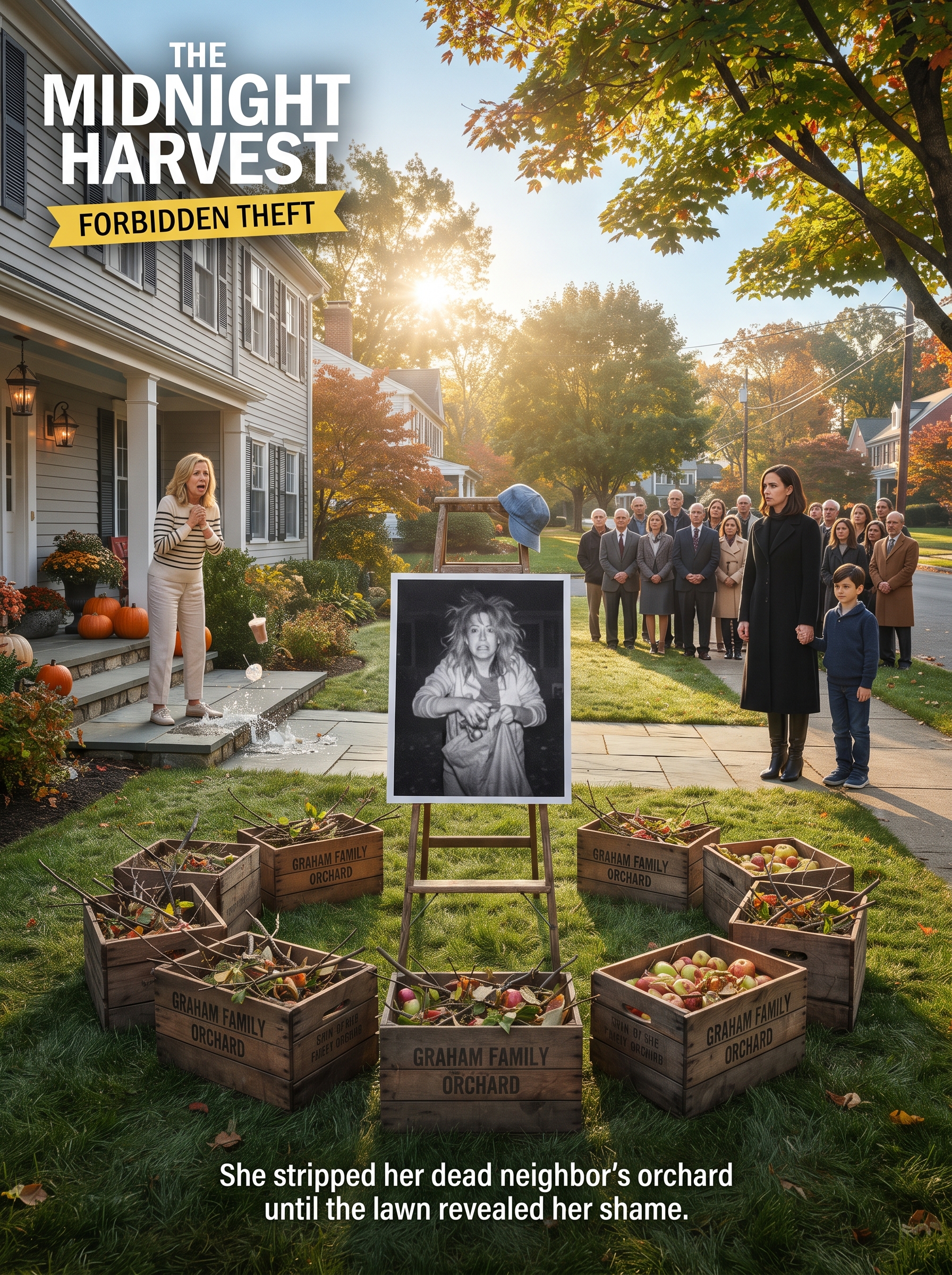
The morning after my husband’s funeral, my neighbor stripped our beloved heritage orchard bare in the dead of night to sell the harvest. Instead of shouting, I waited for dawn and delivered a silent, chilling installation across her manicured yard that brought the entire neighborhood out to witness her shame.
The morning mist was still clinging to the low hollows of our four-acre lot when I pulled my thick fleece robe tight around my chest. The damp grass soaked immediately through the thin canvas of my slippers, but I barely felt the cold. All I could feel was the hollow, echoing ache behind my ribs where Daniel’s presence used to live.
Twelve days.
Twelve days since an unheralded cardiac arrest had stolen the father of my children on a humid Tuesday evening while he was washing his pruning shears by the garden hose.
Those four heritage Honeycrisp trees and the two Bartlett pears by the eastern fence were not merely plants to us. They were Daniel’s sanctuary. When he returned from long, grueling forty-eight-hour shifts as a county paramedic, carrying the unspoken trauma of other people’s ruined lives, he went straight to the trees. He knew every graft, every scar on the bark, and every blossom that opened in April.
Last autumn, when our nine-year-old son Ben had struggled after being cut from the town soccer squad, Daniel had brought him to the base of the largest apple tree.
“Look at this lower limb, Ben,” Daniel had said, his voice low and warm, placing his calloused palm against the boy’s shoulder. “A heavy storm split it three years back. I had to brace it with wire and wax. But look at it now—it bears the sweetest fruit on the whole lot. Hurt doesn’t mean finished. These trees will keep taking care of you, even when I’m not here.”
Now, standing under those very same boughs at five-thirty in the morning, my fingers brushed bare, stripped bark.
It wasn’t just that the fruit was gone. It was the absolute violence with which it had been taken.
Fruiting spurs that took half a decade to develop had been ruthlessly snapped off. Low-hanging limbs were cracked downward, their pale inner wood splintered like broken ribs. Beneath my feet, the dew-soaked turf was littered with ripped leaves, unripe windfalls crushed beneath heavy tread marks, and Daniel’s weathered wooden picking ladder—the one he had built by hand from old ash boards—lying discarded on its side in the mud.
My gaze drifted past the splintered cedar fence toward Monica’s two-story colonial.
Her kitchen window was glowing with a harsh, yellowish light. Even from fifty yards away, through the morning fog, I could see the silhouette of her floral apron moving back and forth across the counter.
Monica had lived next door for six years. Her husband was a regional commercial developer who spent four days a week in Atlanta, while Monica maintained an iron grip on the local neighborhood association. She was a woman who measured human worth entirely by external curation: her flower beds were professionally edged every Thursday, her luxury crossover SUV was detailed twice a month, and she treated our modest four-acre parcel—with its weathered barn, wild honeybees, and untamed berry patches—as an unzoned eyesore that threatened her property valuation.
When she had caught her blouse on our fence yesterday afternoon, bare hours after we had lowered Daniel into the red clay of Oakridge Cemetery, her callous words had stunned me into silence: “Well, he’s not here anymore, is he? Most of it would probably rot anyway.”
I had believed, in my naive, mourning fog, that looking into the eyes of a weeping nine-year-old boy clutching his dead father’s baseball cap would awaken some buried ember of human decency in her.
Instead, she had simply waited for our bedroom lights to flick off.
She had crept through the darkness with buckets and shears, stripping three hundred pounds of fruit from trees planted by a dead man’s hands, treating our grief as a convenient harvesting schedule.
“Mom?”
I turned. Ben was standing at the edge of the flagstone patio, his small hands buried deep in the pockets of his flannel pajama bottoms, his bare feet blue with the morning chill. He looked past me at the stripped, wounded branches.
His face didn’t crumple into tears. It did something far worse.
It settled into a flat, lifeless defeat—the look of a child who realizes that the world outside his doorstep is entirely devoid of mercy.
“She took Dad’s apples, didn’t she?” he whispered.
I walked over, knelt in the wet clover, and pulled him against my chest. His little body was trembling, his fingers clutching the fabric of my robe just as they had clutched Daniel’s cap at the church.
“Yes, sweetheart,” I said quietly, pressing a kiss into his messy morning hair. “She took them.”
“Are we going to call the police?” he asked against my neck. “Or go scream at her?”
I looked over his shoulder toward Monica’s glowing kitchen, watching her load large, clear plastic crates into the open hatchback of her car in the driveway. A police report would produce an indifferent deputy, a fifty-dollar petty larceny citation, and weeks of sneering gossip at the community mailbox. Shouting would only paint me as an unhinged, hysterical widow lashing out in her sorrow.
“No, Ben,” I told him, standing up, taking his small, cold hand in mine. “We aren’t going to scream. We aren’t going to say a single word to her.”
“Then what are we going to do?”
“We are going to make sure,” I said, feeling a cold, crystalline stillness settle over my racing heart, “that Monica never forgets the taste of what she stole.”
I walked back into our house, locked the rear glass door, and went straight to Daniel’s workshop in the basement.
The workshop still smelled of cedar shavings, gun oil, and dried tobacco. His denim work jacket hung from a peg by the door, the elbows molded to the shape of his arms. On his workbench sat his high-resolution hunting trail-camera system—four weatherproof infrared digital units he had set up along the orchard perimeter two summers ago to monitor deer during the late-season rut.
I took the master wireless receiver hub from the wall bracket, plugged the auxiliary cable into my laptop, and waited for the internal solid-state drive to mount.
At 1:14 a.m., Camera 2—mounted inside the hollow of an old hickory tree near the property line—had triggered.
The infrared night-vision footage was razor-sharp, illuminated in high-contrast monochrome.
There was Monica, wearing heavy gardening gloves, dark rubber boots, and a quilted vest. With her was her nineteen-year-old nephew, a college sophomore who worked weekends at the regional farmers’ market on the highway.
For two hours and forty minutes, the camera recorded everything.
It captured them dragging Daniel’s personal orchard ladder across the boundary line. It captured Monica reaching into the highest branches of the Honeycrisp trees, violently twisting limbs until they snapped, laughing quietly as her nephew caught the falling fruit in ten-bushel burlap sacks.
At 2:48 a.m., the audio microphone on Camera 1 picked up her voice clearly over the rustle of leaves:
“Hurry up with the Bartlett pears, Kyle. That organic farm stand outside Hendersonville pays six dollars a pound for unblemished heritage fruit. We’ll clear twelve hundred dollars before noon. The widow won’t even notice until Monday, and by then, they’re already pies.”
I didn’t blink. I didn’t gasp.
I saved the raw video files to two encrypted flash drives. Then, using Daniel’s heavy-duty commercial color label printer—the one he used to label his honey jars and nursery rootstocks—I began to work.
I selected the clearest high-resolution still frame from the footage.
It captured Monica’s face in dead center: flashlight in her mouth, her hands gripping a snapped branch of Daniel’s prized Honeycrisp tree, five bulging sacks stacked at her feet, and a manic, triumphant grin plastered across her features.
Beneath the image, in bold, clean block typography, I typed three lines:
DANIEL GRAHAM’S MEMORIAL HARVEST PLANTED: APRIL 2018. TENDED WITH LOVE FOR 6 YEARS. STOLEN: OCTOBER 14, 2026 — 2:15 AM (12 DAYS AFTER HIS FUNERAL). SOLD BY: MONICA REED — PROUD NEIGHBOR & CIVIC LEADER. “THE PROCEEDS WILL BE CASH ONLY.”
I printed seventy-five copies on heavy, waterproof, self-adhesive vinyl sheets.
Then I walked out to the detached barn.
Sitting along the cedar wall was Daniel’s collection of thirty antique wooden bushel crates—heirloom crates he had collected from old orchardists across the county, each one bearing the deep, heat-branded stencil: GRAHAM FAMILY ORCHARD — SWEET WATER CREEK.
I loaded twelve of those wooden crates into the bed of my riding mower’s utility trailer.
Beside them, I loaded Daniel’s broken ash ladder, three dozen snapped boughs littered with dead leaves, and forty pounds of the bruised, crushed green windfalls Monica and her nephew had trampled into the mud while stripping the boughs.
By seven-fifteen in the morning, the suburban neighborhood of Sweetwater Ridge was beginning to stir.
Sprinklers were hissing along the emerald lawns. School buses were beginning their initial runs along the perimeter boulevard, and corporate commuters in sedans were pulling out of garages.
I backed my trailer out of the barn.
I did not creep in the dark like a thief.
I operated in broad, blinding daylight.
Wearing the dark wool mourning coat I had worn to my husband’s graveside service twelve days earlier, my hair pinned back with severe discipline, I drove the tractor straight across our front lawn, turned onto the public asphalt road, and pulled directly up to the manicured, weed-free curb of Monica Reed’s front yard.
Monica’s front yard was the crown jewel of her neighborhood vanity.
It was a rolling half-acre of laser-graded Kentucky bluegrass, bordered by sculpted brick retaining walls, imported white azaleas, and a crushed-slate circular driveway that led to a massive portico supported by white fluted columns.
At seven-twenty in the morning, her driveway was empty of vehicles; her husband’s Mercedes was parked inside the closed garage, and her nephew’s pickup truck—loaded with the stolen harvest under a blue plastic tarp—sat idling in the rear service bay near the alley, ready for its morning trip to the highway market.
I stepped down from the tractor seat.
My movements were quiet, deliberate, and unhurried.
I unhitched the utility trailer. Then, starting at the edge of her pristine brick sidewalk, I began to unpack the crates.
I arranged eight of Daniel’s weathered, heat-branded wooden crates in a solemn, rectangular perimeter directly across the center of her front lawn, right beside her brass mailbox.
Inside the first three crates, I didn’t place shiny apples.
I placed the evidence of her destruction: the jagged, splintered branches she had wrenched from our trees, their torn leaves wilting in the morning sun, still weeping amber sap onto the aged wood.
In the next three crates, I poured the bruised, ruined windfalls she had trampled into the dirt—crushed, half-eaten by wasps, and coated in sticky morning clay.
Across the center of the display, I stood Daniel’s broken wooden picking ladder upright, anchoring it into the soft turf with two iron garden stakes.
Draped across the top rung of the ladder was Daniel’s faded denim orchard cap—the very hat Ben had clutched against his chest while Monica sneered over our fence.
And onto every single surface—the crates, the ladder rungs, the brick retaining pillars, and Monica’s polished black mailbox—I applied the waterproof vinyl placards.
The large, glossy photographs of Monica’s face, caught in monochrome infrared with a flashlight clenched between her teeth while snapping our boughs at two in the morning, stared out at the street in terrifying, indisputable clarity.
On the center crate, positioned directly below Daniel’s cap, I set a large, laminated cardboard collection jar with a handwritten note taped to the glass:
“FOR MONICA’S CONVENIENCE: IF YOU PURCHASED STOLEN FRUIT FROM 442 SWEETWATER LANE THIS MORNING, PLEASE DEPOSIT YOUR PAYMENT HERE. DANIEL’S ORPHANED CHILDREN THANK YOU FOR YOUR GENEROSITY.”
By seven-forty, the street had come alive.
Mrs. Gable, an elderly woman who walked her golden retriever past our houses every single morning at quarter to eight, was the first to stop.
She slowed her pace, adjusting her sunglasses, her gaze moving from the antique wooden crates to the broken branches, and finally to the large, full-color vinyl placard displaying Monica’s face.
She walked closer, leaning over the mailbox to read the bold black text: “STOLEN: OCTOBER 14, 2026 — 2:15 AM (12 DAYS AFTER HIS FUNERAL).”
Mrs. Gable’s hand flew to her mouth, an audible gasp escaping her throat.
“Oh, sweet Lord above,” she whispered aloud, looking from the display toward Monica’s closed front door, her eyes wide with total, unadulterated horror.
Two minutes later, an SUV carrying four neighborhood mothers on the elementary school carpool run slowed to a crawl along the curb.
The driver rolled down her window, staring at the installation in stunned silence. The passenger pointed her smartphone through the glass, taking rapid photographs of the infrared still frame, her mouth hanging slightly open.
Within ten minutes, four more cars had pulled over to the shoulder.
Commuters on their way to work stopped their engines. Neighbors came out in their bathrobes, holding mugs of coffee, clustering together in hushed, agitated knots on the opposite sidewalk, pointing at the display, murmuring with mounting disgust.
“Is that… is that Monica?” “Look at the ladder! That’s Daniel Graham’s ladder!” “Twelve days after the funeral? What kind of monster does that?!”
At precisely seven-fifty-two, the heavy white front door of the Reed residence swung open.
Monica stepped onto the stone porch.
She was dressed for a morning of triumphant commercial enterprise: clean linen trousers, a silk scarf tied neatly at her throat, her hair freshly curled, carrying an iced latte in one hand and her car keys in the other.
She had that bright, brisk, dismissive air of a suburban queen about to conduct business.
She took three steps down the flagstone stairs, glancing toward her front gate to see why three idling cars were blocking her curb.
Then her eyes adjusted.
She saw the crowd of twenty neighbors standing silently along her sidewalk.
She saw the antique wooden crates.
She saw the broken boughs of Daniel’s trees.
And then, she saw the fifty high-resolution photographs of her own face, caught in the act of nighttime theft, plastered across every square foot of her pristine front yard.
The iced latte slipped from Monica’s fingers, shattering with an explosive, creamy splash against the flagstones.
A high, piercing, animal scream tore from her throat—a sound so shrill and violent that dogs began barking three streets away.
She stumbled down the steps, her manicured hands clutching her cheeks, her face draining of all color until she looked like a wax mannequin melting in the sun.
“NO!” she shrieked, her voice cracking into a ragged, hysterical wail. “WHAT IS THIS?! WHO DID THIS?!”
From across the street, standing quietly on my own driveway with my hands folded in the pockets of my black mourning coat, I took one slow step forward into the morning sun.
Monica’s scream died in her throat as her eyes found mine across the asphalt.
For three seconds, she stood entirely paralyzed on her manicured grass, surrounded by Daniel’s broken branches and the seventy-five glossy images of her nighttime betrayal.
The twenty neighbors lining the sidewalk did not look away. Nobody offered a comforting word. Nobody stepped forward to help her. They stood like a silent jury in their bathrobes, business suits, and athletic wear, their faces hardened into stone.
“Claire!” Monica shrieked, finding her voice, her tone shifting from terror into a desperate, screeching defensive rage. She pointed a trembling, manicured finger at me. “You… you psychotic, vindictive bitch! How dare you trespass on my lawn! How dare you defame my character in front of my neighbors?!”
She lunged toward the nearest crate, her fingers tearing frantically at the vinyl placard.
The heavy-duty waterproof adhesive Daniel had used for his commercial honey jars was designed to withstand rain, sub-zero frost, and UV rays; the vinyl resisted, tearing only in tiny, jagged corners, leaving Monica’s grinning monochrome face firmly attached to the weathered oak.
“Take it down!” Monica screamed at the crowd, her chest heaving as tears of pure humiliation began to streak her makeup. “Take these things off my grass! Someone call the police! She’s vandalizing my property! She’s slandering me!”
“It isn’t slander if it’s documented, Monica,” a voice boomed from the curb.
Dr. Walter Evans, a retired chief of surgery who had lived on the ridge for twenty-two years and had attended Daniel’s funeral on Sunday, stepped forward onto the edge of her grass. He adjusted his wire-rimmed glasses, looking down at the crate containing the trampled fruit.
“I looked at that image, Monica,” Dr. Evans said, his deep, authoritative voice cutting through her hysterical screams like a scalpel. “That is your face. That is your quilted vest. And that is Daniel Graham’s ladder.”
“He told me I could have them!” Monica lied, the words spilling out in a frantic, stumbling torrent. “Daniel told me weeks ago… before he got sick… he said the harvest was too much for Claire to handle! He told me to clear the trees!”
From behind me on our driveway, the screen door clicked open.
Nine-year-old Ben walked down our front steps, holding his three-year-old sister Lily by the hand. He walked slowly, stopping beside my coat, looking across the street directly into Monica’s wild, panicked eyes.
“My dad never gave you anything,” Ben said.
His voice was not loud. It did not carry the shrill fury of an adult. It was the clear, piercing truth of a child who has been robbed of his sanctuary.
“My dad spent four years nursing those trees,” Ben told the watching neighborhood. “He told me on the porch that those apples would keep taking care of us when he was gone. You climbed over our fence while we were putting on our funeral clothes yesterday. You told my mom that Dad was dead and that the fruit would just rot.”
A collective, shuddering gasp rippled through the gathered crowd.
Mrs. Gable turned her face away in sheer, unadulterated disgust.
Two of the mothers from the carpool stepped out of their SUV, their expressions radiating pure, withering contempt.
“You did that to a nine-year-old boy, Monica?” one of the mothers whispered, her voice trembling with rage. “On the day of Daniel’s funeral?”
“It’s a lie!” Monica wailed, backing toward her front porch steps, her hands fluttering against her throat as if she were suffocating. “They’re twisting it! They’re trying to destroy my family because they’re jealous of our home!”
From the alleyway behind her property, the loud, grinding transmission of her nephew’s pickup truck sounded as Kyle tried to ease out of the rear driveway toward the main road.
Before the truck could clear the curb, Dr. Evans and two other neighbors—men who had known Daniel since high school—stepped directly into the asphalt lane, blocking the vehicle’s path.
“Kill the engine, Kyle,” Dr. Evans commanded, resting his flat palm against the truck’s hood.
The nineteen-year-old boy looked through the windshield, his face pale as milk, his eyes wide with terrified guilt.
He didn’t argue. He turned off the ignition.
One of the neighbors reached into the open bed of the truck, grabbed the corner of the blue plastic tarp, and yanked it backward with a violent, snapping flourish.
There, stacked four crates high, were sixteen plastic bins overflowing with Daniel’s Honeycrisp apples and Bartlett pears—scented with the sweet, crisp perfume of our family’s orchard, tagged with hand-printed wholesale price stickers: $6.00 / lb — Heritage Mountain Fruit.
The evidence was absolute. It was undeniable.
At that precise moment, the low, pulsing wail of a county sheriff’s siren broke through the morning air, accompanied by the slow, deliberate crunch of gravel as two patrol cruisers turned onto Sweetwater Lane.
Deputy Sheriff Marcus Vance—a broad-shouldered man in his late forties whose father had served on the volunteer fire department with Daniel for twenty years—stepped out of the lead cruiser.
He didn’t rush. He adjusted his duty belt, his sharp brown eyes taking in the entire scene: the crowd of twenty-five neighbors lining the curb, the utility trailer, the wooden crates arranged across the lawn, the nineteen-year-old nephew frozen behind the wheel of the idling truck, and Monica Reed standing on her stone steps, trembling like a leaf in an October gale.
“Deputy! Thank God you’re here!” Monica screamed, practically tumbling down her porch stairs, clutching at his sleeve. “I want her arrested! Right now! That woman has vandalized my property, dumped garbage on my grass, and posted defamatory lies across my neighborhood! Look at this! Look at what she’s done to my home!”
Deputy Vance gently but firmly removed her manicured hands from his uniform jacket, stepping back half a pace.
“Calm down, Mrs. Reed,” Vance said, his voice flat, professional, and entirely devoid of neighborly warmth. “We received three separate emergency calls from this street in the last ten minutes.”
He walked over to the nearest crate, leaning down to examine the high-resolution infrared still frame. He looked at the image for a long, silent moment, his jaw muscles clenching tight beneath his skin.
He turned his head slowly, looking past Monica toward the pickup truck in the alley where the blue tarp lay peeled back over sixteen bins of fresh fruit.
“Mrs. Graham,” Deputy Vance called out, looking across the street toward where I stood with Ben and Lily. “Are these your crates?”
I walked forward, stopping at the boundary line of Monica’s grass.
“The wooden crates belong to my late husband, Deputy,” I said, my voice steady, clear, and unhurried. “The fruit inside that truck was harvested from four trees on our deeded property between the hours of one-fourteen and three-fifty-five this morning, without permission, following a verbal trespass warning issued at four o’clock yesterday afternoon.”
I reached into the pocket of my wool coat, pulled out an encrypted flash drive, and handed it to the deputy.
“That drive contains four angles of high-definition infrared video with synchronized audio,” I continued. “It documents Mrs. Reed and her nephew using our personal ladder, snapping fifty-four fruiting spurs, and discussing the commercial sale of the harvest for twelve hundred dollars at the Hendersonville regional market.”
Monica gasped, her hands flying to her mouth. “You… you had cameras?!”
“My husband was a paramedic and an orchardist, Monica,” I said softly, looking directly into her wide, panicked eyes. “He was meticulous about protecting what he loved.”
Deputy Vance plugged the drive into the mobile data terminal inside his patrol car.
For two minutes, the only sound on Sweetwater Lane was the rustle of autumn leaves and the low murmur of neighbors conferring on the sidewalk. Through the open window of the cruiser, Monica’s own voice drifted out across the street, tinny but unmistakable:
“…Hurry up with the Bartlett pears, Kyle. That organic farm stand pays six dollars a pound… The widow won’t even notice until Monday…”
Deputy Vance closed the terminal screen.
When he stepped back out of the vehicle, his face was like carved mountain granite.
He walked past Monica, straight toward the pickup truck in the alley.
“Kyle Reed,” Deputy Vance commanded. “Step out of the vehicle and keep your hands where I can see them.”
The nineteen-year-old boy climbed down from the cab, sobbing openly, his knees shaking. “Deputy, I’m sorry! Aunt Monica told me she had bought the picking rights! She said she paid Mrs. Graham five hundred dollars yesterday! I didn’t know they were stolen!”
“Shut up, Kyle!” Monica shrieked from the porch. “Shut your mouth!”
“Turn around, Kyle,” Deputy Vance instructed, pulling a pair of steel handcuffs from his belt. “You’re being detained for possession of stolen agricultural property valued over one thousand dollars.”
The metallic click of the handcuffs ratcheting around the boy’s wrists was loud in the morning air.
Deputy Vance then turned his attention back to the stone steps.
“Mrs. Monica Reed,” the deputy said, walking toward her with measured, heavy steps. “Under North Carolina General Statutes, Section fourteen-seventy-two, grand larceny of commercial agricultural produce is a Class H felony. Furthermore, given the structural damage to the boughs and the unauthorized nighttime entry, you are being charged with criminal trespass in the first degree and felony injury to real property.”
Monica backed up three steps, her back hitting the heavy white columns of her porch.
“No,” she whimpered, her voice cracking into a thin, breathless squeak. “No… you can’t arrest me. My husband is on the county planning commission! He knows the district attorney! You can’t put handcuffs on me in front of my neighbors!”
“Hands behind your back, ma’am,” Deputy Vance replied, unholstering a second pair of cuffs. “Do not make this difficult.”
“Claire! Tell him!” Monica screamed, looking toward me with wild, animal terror in her eyes. “Tell him we can settle this! I’ll pay you! I’ll pay you five thousand dollars! I’ll buy new trees! Just tell him to stop!”
I looked at Monica.
I looked at the floral blouse she had caught on my fence yesterday, the silk scarf at her neck, and the desperate, naked entitlement that still pulsed through her veins.
“My husband didn’t grow those trees for five thousand dollars, Monica,” I said, my voice tranquil, mournful, and absolute. “He grew them to teach his son how to feed his family. Some things do not have a price tag.”
The steel cuffs snapped shut around Monica’s manicured wrists.
A collective cheer—spontaneous, sharp, and triumphant—erupted from the twenty-five neighbors gathered along the curb.
People applauded. Mrs. Gable shook her head with tears in her eyes, while two fathers walked over to the utility trailer to help lift Daniel’s broken ladder back into place.
Monica was guided down the stone steps, weeping hysterically, her designer clothes disheveled, her head bowed in total, unmitigated shame as the rear door of the patrol cruiser slammed shut behind her.
By noon, Sweetwater Lane had settled into a completely altered reality.
The two patrol cruisers had departed, carrying Monica and her nephew toward the county detention facility in Asheville for formal booking.
The sixteen bins of stolen fruit had been carefully unloaded from Kyle’s pickup truck by four neighborhood fathers and transported back across the street to our driveway, covered with clean cotton sheets to protect them from the midday sun.
Monica’s front yard remained exactly as I had arranged it.
Deputy Vance had informed her that because the installation was located entirely within the public utility easement and documented an active criminal investigation, the county would not remove the display until the formal property survey was completed on Monday morning.
Seventy-five photographs of Monica’s grinning, nighttime theft continued to stare out at the street.
Cars from two neighboring subdivisions—having seen the footage that Dr. Evans and the carpool mothers had uploaded to regional community groups—were now driving slowly past the house, their passengers craning their necks, photographing the broken boughs, shaking their heads in disgust.
At one o’clock, the roar of a powerful engine broke the afternoon quiet.
A sleek black luxury sedan came speeding down Sweetwater Lane, its tires screeching as it pulled violently into Monica’s driveway, narrowly missing the broken crates on the grass.
The driver’s door flew open.
Greg Reed, Monica’s husband, stepped onto the crushed slate.
He was a tall, sharp-featured man in his early fifties, wearing an expensive tailored suit, his tie loosened, his hair wildly disheveled from a frantic two-hour drive from Charlotte after receiving the frantic call from the county jail.
He took one look at his front lawn.
He saw the crates.
He saw Daniel’s broken ladder.
He saw seventy-five full-color images of his wife caught like a raccoon in an orchard, and the large collection jar inviting neighbors to donate to Daniel’s orphaned children.
Greg stopped dead in his tracks.
His face cycled through three distinct shades of color: from furious crimson, to a sickly gray, and finally settling into a hollow, ghastly white.
He walked slowly across the grass, reading the text on the central placard: “STOLEN: OCTOBER 14, 2026 — 2:15 AM (12 DAYS AFTER HIS FUNERAL).”
He leaned his forehead against the roof of his car, letting out a long, shuddering groan that sounded like an animal in a snare.
He had spent ten years building his reputation as an elite commercial contractor in western North Carolina. He had served on philanthropic boards, donated to municipal campaigns, and curated an image of immaculate, high-society success.
And in a single morning, his wife had reduced that reputation to a pile of bruised, stolen apples on a suburban lawn.
Slowly, Greg turned toward our house.
He straightened his jacket, wiped a hand across his sweating forehead, and walked across the asphalt of Sweetwater Lane.
I was sitting on our front porch swing, holding a sleeping Lily in my lap, while Ben sat on the wooden steps beside me, carving a small cedar peg with Daniel’s pocketknife.
Greg walked up our flagstone path, his steps heavy, halting, and uncertain.
He stopped at the bottom of the porch stairs. He took off his gold-rimmed sunglasses, holding them in trembling fingers, looking up at me with an expression of profound, crushing humiliation.
“Claire,” Greg whispered, his voice cracking into a dry, hoarse rasp.
I did not stand up. I did not raise my voice. The rhythm of the porch swing remained steady and slow.
“Hello, Greg,” I said.
“I… I just came from the magistrate’s office,” Greg stammered, his eyes avoiding Ben’s clear, steady gaze. “The bail was set at twenty-five thousand dollars. The district attorney is refusing to reduce the felony charges because of the commercial value and the trespassing history.”
“The evidence is very clear, Greg,” I replied softly.
“Claire, please,” Greg choked out, stepping up one stair, his hands clenching into fists at his sides. “Monica… Monica has a sickness. She’s obsessed with money, with status, with cutting corners. I knew she was petty, but I swear on my mother’s soul, I did not know she was capable of this. I did not know she would defile Daniel’s memory.”
Tears welled in the grown man’s eyes, spilling over his cheeks, splashing onto his tailored silk tie.
“What do you want, Claire?” Greg wept, his voice dropping into a desperate, broken whisper. “Tell me what you want. I will pay you thirty thousand dollars for the orchard. I will hire a master landscaper to plant twenty mature Honeycrisp trees in your yard tomorrow morning. I will pay for Ben and Lily’s college accounts. Just… please… take the display down from my lawn. The local news trucks are already filming at the entrance of the neighborhood.”
I stopped the swing with the toe of my shoe.
I looked down at the developer—a man who had spent his life believing that every mistake could be bulldozed, every crime settled with an insurance check, and every human wound paved over with money.
“Greg,” I said gently, looking him straight in his eyes.
“Yes, Claire?” he pleaded, a spark of pathetic hope flashing in his face.
“The display stays until Monday morning,” I told him, every word falling like an iron weight into the silence. “Your wife didn’t steal thirty thousand dollars of landscaping. She stole twelve days of our peace. She took the last harvest my children will ever have from their father’s hands, and she tried to turn it into twelve hundred dollars of pocket cash.”
I pointed toward his front lawn across the street.
“Your yard looks like our orchard looks today, Greg: broken, stripped, and exposed to the light. If you want those crates moved, you will leave them there until every single family in this town understands what your wife did in the dark.”
Greg stood frozen on the step.
He looked at my face—looked at the quiet, unbreakable granite of a grieving mother who could not be bought, intimidated, or flattered.
Slowly, his shoulders slumped. He lowered his head, a single, broken sob escaping his throat.
“I’m sorry, Claire,” he whispered. “God forgive us… I am so sorry.”
He turned on his heel, walked back across the street with his head bowed, and climbed into his luxury car, leaving the broken harvest of his wife’s greed standing tall beneath the October sun.
The news of the “Orchard Ambush” on Sweetwater Lane swept across the county like a dry prairie fire.
By Saturday morning, an article written by a regional investigative reporter—accompanied by high-resolution photographs of Daniel’s ladder standing in the center of Monica’s manicured lawn—had appeared on the front page of the Asheville Citizen-Times:
“Suburban Civic Leader Arrested for Felony Theft of Late Paramedic’s Heritage Orchard.”
The public reaction was immediate, overwhelming, and fierce.
Monica was removed from the neighborhood association board within two hours of the article’s publication. The regional charity galas she had chaired canceled her memberships, and the private country club in Biltmore Forest issued a formal letter barring her from the premises pending the outcome of her criminal trial.
Greg Reed, facing catastrophic reputational fallout among his commercial development partners, announced on Sunday evening that he was placing their two-story colonial on the market and moving his firm’s operations permanently to Georgia.
Across the street, at our modest four-acre lot, something entirely different was taking root.
On Saturday afternoon, a battered blue pickup truck rumbled up our gravel drive.
Out stepped Thomas Caldwell, a seventy-year-old master arborist who had run the county nursery for forty years and had been one of Daniel’s closest horticultural mentors.
Behind him were four members of the Western North Carolina Fruit Growers Association, carrying heavy tool chests, cans of organic grafting sealant, pruning saws, and spools of specialized horticultural bracing wire.
“Claire,” Thomas said, taking off his battered felt hat, his weathered face creased with profound sorrow. “We saw the paper. We came to see Daniel’s trees.”
I walked with them to the eastern fence.
For three hours, the five veteran orchardists moved through the four stripped Honeycrisp trees and the two Bartlett pears with the reverent, tender care of surgeons tending wounded soldiers.
They did not rush.
They cleanly dressed every jagged fracture Monica’s shears had torn into the wood. They applied protective bee-propolis wax to the exposed cambium layers, carefully braced the broken lower limbs with soft hemp webbing and hickory splints, and treated the root zones with rich, organic mycorrhizal compost to help the trees weather the coming winter frost.
“She bruised them, Claire,” Thomas told me, resting his hand against the trunk of the oldest apple tree, looking up through the bare branches. “She took two seasons of fruit wood off these upper limbs. But Daniel knew what he was doing when he set these rootstocks. The taproots are deep, into solid mountain limestone. They’ll sleep through the freeze, and come April… they’ll blossom twice as hard just to spite her.”
While the arborists worked in the orchard, our front porch had become a sanctuary of community devotion.
Neighbors who had barely exchanged nods at the mailbox began streaming up our walkway.
They brought covered dishes: chicken pot pies, hot beef stews, fresh sourdough loaves, and jars of wild blackberry preserves.
Mrs. Gable arrived with an envelope containing seven hundred dollars—collected quietly from thirty families on Sweetwater Lane—to help purchase winter fuel for our house.
And then, at four o’clock on Sunday afternoon, our neighbor Sarah—a mother of three who ran a small commercial cider press three miles down the valley—pulled into the driveway with an industrial hydraulic pressing rig mounted on a flatbed trailer.
“Claire,” Sarah said, stepping down from the truck with a bright, determined smile. “You have three hundred pounds of bruised Honeycrisps and Bartlett pears sitting in those crates. We aren’t going to let a single ounce of Daniel’s harvest rot in the dirt.”
Within thirty minutes, our backyard was transformed into a festival of labor and laughter.
Ten neighborhood parents and eight children gathered around the washing bins.
Ben stood at the sorting table, Daniel’s faded orchard cap perched firmly on his head, showing the younger children how his father had taught him to core the fruit and cut away the bruised sections where Monica’s boots had trampled them.
The antique hand-crank grinder chewed through the crisp fruit, filling the autumn air with the intoxicating, sweet perfume of fresh apples and crushed pear skins.
The hydraulic press groaned against the wooden racks, and out poured streams of liquid gold—thick, unfiltered, fragrant cider, cascading into clean glass gallon jugs that caught the afternoon sun like honey.
By dusk, we had pressed forty-eight gallons of Daniel Graham’s Memorial Harvest Cider.
Every family who had helped took two jugs home.
The remaining twenty-eight jugs were placed in Daniel’s old refrigerated milk cooler in the barn, reserved for the winter evenings ahead.
As the sun sank behind the ridge, washing our bare trees in glorious shades of amber and rose, Ben walked over to the base of the oldest tree.
He rested his palm against the newly splinted bark, his small fingers tracing the protective wax Thomas Caldwell had smoothed over the wound.
“Dad was right, Mom,” Ben whispered, looking back at me with clear, untroubled eyes.
“About what, sweetheart?” I asked, kneeling beside him in the clover.
“The trees,” Ben said, a small, beautiful smile touching his lips. “They’re still taking care of us.”
I pulled my son close, listening to the laughter of our neighbors packing up their tools, feeling the great, unbroken circle of my husband’s love holding us fast against the cold.
The winter that followed was the quietest Sweetwater Ridge had ever known.
By late November, the colonial house across the street stood dark, silent, and abandoned.
A large commercial real estate sign was staked into the frosty lawn where the wooden crates had stood: FOR SALE — BANK-ORDERED EXPEDITED LIQUIDATION.
Monica Reed had pleaded guilty in Buncombe County Superior Court to reduced charges of felony grand larceny and criminal trespass.
Under the terms of her plea agreement, brokered by her husband’s high-priced criminal attorneys to avoid an active prison sentence, Monica was placed on five years of supervised felony probation, ordered to complete five hundred hours of community service at the county agricultural center, and assessed fourteen thousand dollars in restitution and civil damages.
Part of the judgment included a permanent lifetime restraining order forbidding her from entering Sweetwater Lane or coming within five hundred yards of our family.
They moved to an anonymous gated enclave outside Savannah three days before Christmas, their moving vans loading in the dead of night, leaving behind an empty house and a reputation that had turned to ashes.
Inside our home, the winter was warm.
Every Sunday evening, Ben, Lily, and I would sit beside the woodstove, warming a kettle of Daniel’s cider on the cast-iron plate, adding a stick of cinnamon and a slice of dried orange.
The cider was rich, sweet, and complex, carrying the crisp mountain sunlight of an autumn we would never forget.
Ben did not look at the bare trees outside with sorrow anymore.
Every Saturday morning, he walked the perimeter of the orchard with a small notebook, checking the splints, clearing the heavy snow from the lower branches, recording the swelling of the terminal buds with the disciplined, patient dedication of his father.
In early March, a certified cashier’s check for fourteen thousand dollars arrived from the clerk of superior court—the restitution payment from Monica Reed.
I did not deposit the check into our personal savings account.
I did not buy new furniture.
Instead, I walked down to the First National Bank in town, opened a dedicated municipal account, and established The Daniel Graham Community Orchard Endowment.
Partnering with Thomas Caldwell and the county vocational school, the endowment purchased three acres of neglected municipal land adjacent to the community park down by the river.
On the first Saturday of April—a brilliant, crisp spring morning when the redbuds were beginning to purple the hillsides—forty families from Sweetwater Ridge and the surrounding hollows gathered at the new park.
We brought shovels, compost, cedar stakes, and two dozen young heritage apple saplings: Honeycrisp, Northern Spy, Stayman, and Bartlett pear rootstocks, grown from cuttings Thomas Caldwell had taken from Daniel’s trees forty years ago.
Ben, wearing his father’s cap, stood in the center of the fresh black dirt, holding the first sapling straight while three high school apprentices shoveled the rich compost around the root ball.
Beside the gate of the new public orchard, we erected a simple timber archway, carved from native white oak by the neighbors who had pressed cider in our barn.
Carved into the lintel, beneath an engraved spray of apple blossoms, were the words:
THE SWEETWATER MEMORIAL ORCHARD DEDICATED TO DANIEL GRAHAM “THESE TREES WILL KEEP TAKING CARE OF YOU.” FREE TO ALL WHO ARE HUNGRY. PROTECTED BY ALL WHO REMEMBER.
As the crowd cheered, passing around thermoses of warm coffee and sweet apple fritters, I walked back toward our property on Sweetwater Lane.
The spring sun was high in the azure sky, warming the four-acre lot where Daniel had sweated, laughed, and prayed.
I walked to the eastern fence.
The oldest Honeycrisp tree—the one Monica had wrenched with her bare hands six months ago—stood tall against the blue horizon.
Along the scarred limb, right beside the dark wax seal where Thomas had bound the broken wood, three hundred tiny, velvet-pink buds had broken through the gray bark, swelling in the morning warmth, preparing to burst into magnificent, fragrant white blossoms.
I reached out, my fingers resting gently against the rough, living bark, feeling the steady, miraculous pulse of life rising from the deep mountain limestone.
The neighbor who had tried to steal our heritage was gone, swallowed by the silence of her own shame.
But here, in the sunlit dirt where love had been planted, the harvest was eternal—an unbreakable covenant of life, grace, and redemption that no thief could ever touch, and no winter could ever destroy.